How to Paint a Gradient With Acrylics: A Smooth Color Fade
A step-by-step gradient exercise: premix five steps on the palette, paint them as bands, then soften the borders with a clean damp brush. Covers one-color and two-color fades and how to fix stripes.
At a glance
Brushes and materials
- 1 in flat brush for painting
- Second clean flat brush for softening
- Palette knife or old brush for mixing
- Palette and two water jars
- Paper towels
A sky that fades from deep blue overhead to pale near the horizon, a background that drifts from one color into another: both depend on the same skill. Learning how to paint a gradient with acrylics is mostly a matter of preparation, because the paint dries too fast to mix as you go.
The exercise below removes the rush. You mix every step of the fade on the palette first, lay the steps down as bands, and only then soften the borders between them.
Why premixing makes gradients easier
A thin layer of acrylic starts to set within a few minutes and is touch-dry in roughly 10 to 20. If you stop to mix a new color halfway down, the band above it has already begun to dry and will not merge with the next one.
With all the colors ready, you can cover the surface in a minute or two and spend the remaining wet time on the borders. Each neighboring pair of bands is already close in color, so only a little softening is needed.
What you need
- A small canvas panel or a sheet of acrylic paper taped to a board, about 8 x 10 in (20 x 25 cm)
- Ultramarine blue and titanium white, plus a second pair of colors for the later exercise
- A 1 in (2.5 cm) flat brush for painting and a second clean flat for softening
- A palette knife or old brush for mixing, two water jars and paper towels
Exercise 1: a one-color gradient with white
Mix five steps on the palette
- Put out a puddle of ultramarine blue at one end of the palette and a larger puddle of white at the other.
- Between them, mix a middle step: roughly equal amounts of blue and white. Blue is strong, so add it to the white a little at a time.
- Mix a step halfway between pure blue and the middle, and another halfway between the middle and white.
- Check the row. Each puddle should look like an even step from its neighbors. Adjust any that jump.
Mix more than you think you need, about a teaspoon of each. Running out halfway is the most common way this goes wrong. Lightening a color with white produces a tint; the guide to tints, tones and shades explains how that changes a color beyond making it paler.

Paint the bands
- Starting at the top with pure blue, paint a horizontal band across the full width, about a fifth of the height.
- Wipe the brush on a paper towel, without rinsing, and paint the next step directly below, letting it touch the first band.
- Continue down through all five, finishing with white at the bottom. Work quickly and do not fuss with the borders yet.
Soften the borders
- Take the clean flat brush, dip it in water and blot it on a paper towel so it is damp, not wet.
- Starting at the lightest border, place the brush on the line between two bands and pull it straight across in one long horizontal stroke, edge to edge.
- Wipe the brush on the paper towel, then make a second pass slightly above and a third slightly below, so the mixed zone widens.
- Wipe again and move up to the next border. Keep working from light to dark so you do not drag blue into the white.
Use light pressure and resist the urge to scrub up and down. If you want more ways to merge two wet colors, the article on blending acrylic paint covers them in depth.
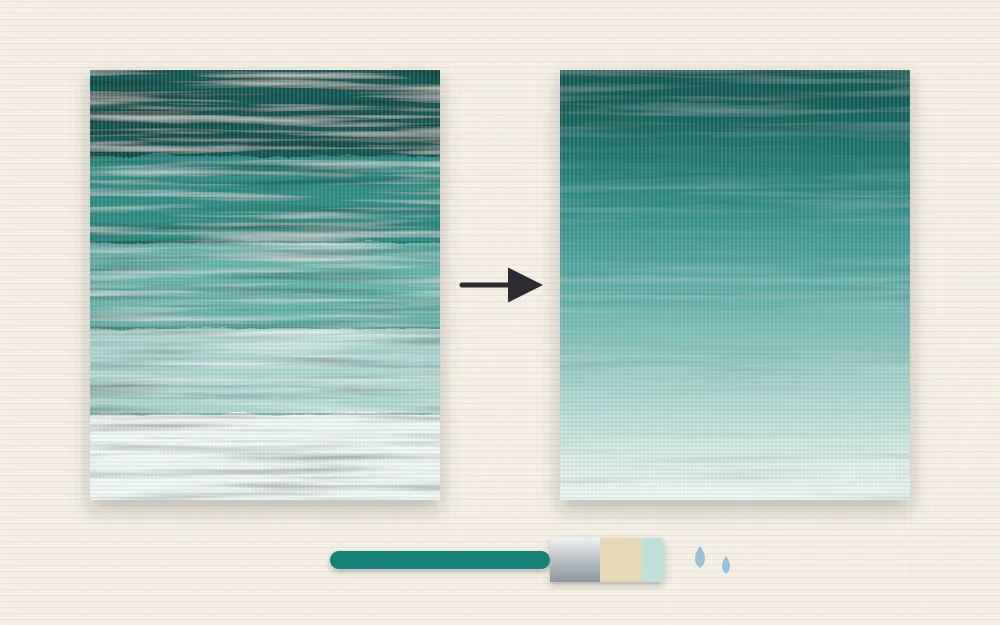
Tip
Wiping the softening brush between passes matters more than anything else. A brush loaded with picked-up paint lays down a new stripe instead of removing the old one.
Exercise 2: a two-color gradient
The method is identical; only the palette changes. Replace blue and white with two colors, such as magenta and primary yellow, and mix three or five steps between them. The middle step here is a clear orange-red.
Three steps are enough when the two colors are similar in value. Use five when one is much darker than the other, as with ultramarine and yellow, because a big jump is harder to hide.
Choosing colors that stay clean in the middle
The middle of a two-color gradient is a mixture of both ends, so check that mixture before you start. Stir a little of each together on the palette and look at the result.
- Neighbors blend cleanly. Yellow into orange, red into magenta, blue into green: the middle is simply the color between them.
- Opposites turn dull. Blue into orange, or violet into yellow, mixes to a gray or brown in the center.
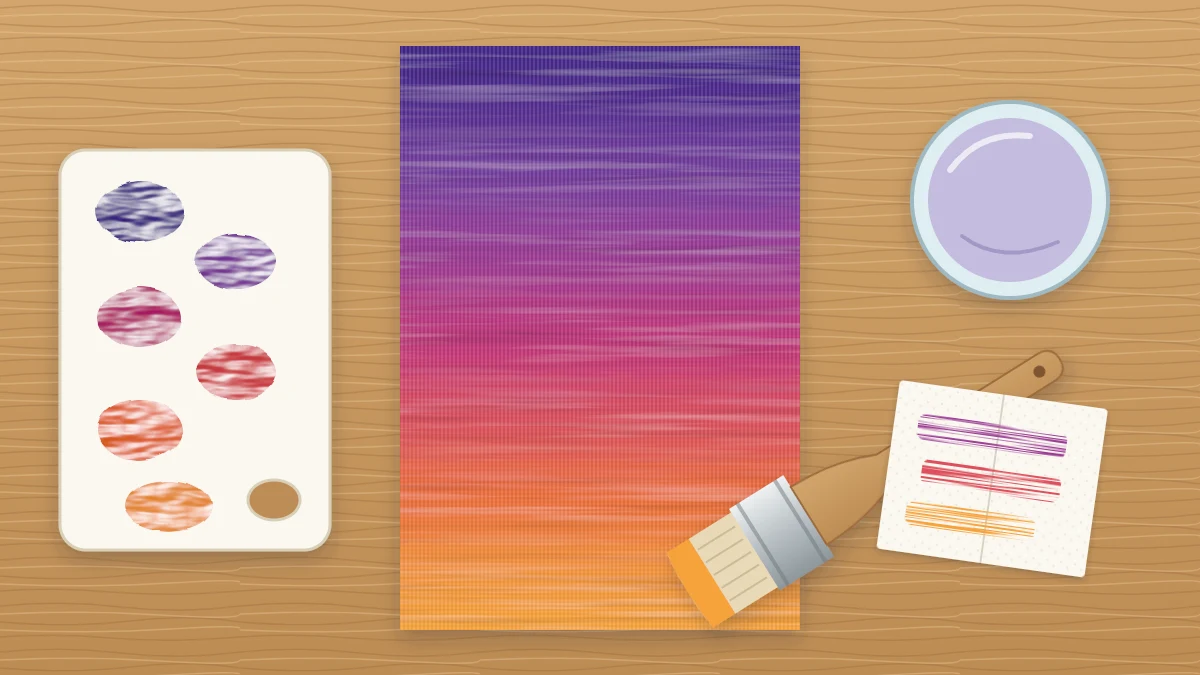
- A bridge color solves it. For a sky that goes from blue to orange, put a band of pale pink or near-white between them, so the blue fades to the light band and the light band fades to orange.
That bridge is how most evening skies are built. The easy sunset painting uses this kind of fade as its whole background.
Fixing bands after the paint has dried
If the result still shows stripes once dry, do not try to rework it with water; dried acrylic is water-resistant and will not move. Paint a second pass instead.
- Let the first layer dry completely.
- Remix the steps, or use what is left if you covered the palette to keep it moist.
- Repaint the bands thinly over the first layer and soften the borders again.
The second pass is easier than the first. The color underneath is already nearly right, so a thinner coat will do, and thin coats soften more readily. For one stubborn stripe, repaint only the two bands on either side of it. Remember that acrylics usually dry slightly darker than they look wet, so judge the fade once it has dried.
Cleaning up
Scrape leftover paint off the palette with a paper towel and wipe the brushes before rinsing them, so less paint goes down the drain. Wash the softening brush well; it carries more paint in its base than it seems to.
Frequently asked questions
Why does my acrylic gradient look streaky?
Usually the softening brush is carrying too much paint or too much water, or the bands had started to dry before you reached them. Mix all the steps first, work fast, keep the brush only damp and wipe it after each pass. A second thin coat hides most remaining stripes.
How many steps should I mix for a gradient?
Three steps work when the two end colors are close in value, and five are better when one end is much darker than the other. More steps mean smaller jumps between bands, so less softening is needed. On a large surface, extra steps are worth the mixing time.
Can I paint a gradient on paper instead of canvas?
Yes. Acrylic paper or heavy mixed-media paper taped flat to a board works well for practice. Paper absorbs moisture faster than a primed panel, so the bands dry a little sooner. Work on a smaller area and keep the paint creamy instead of thin.