How to Paint a Sky in Acrylic: Blue Gradients and Soft Clouds
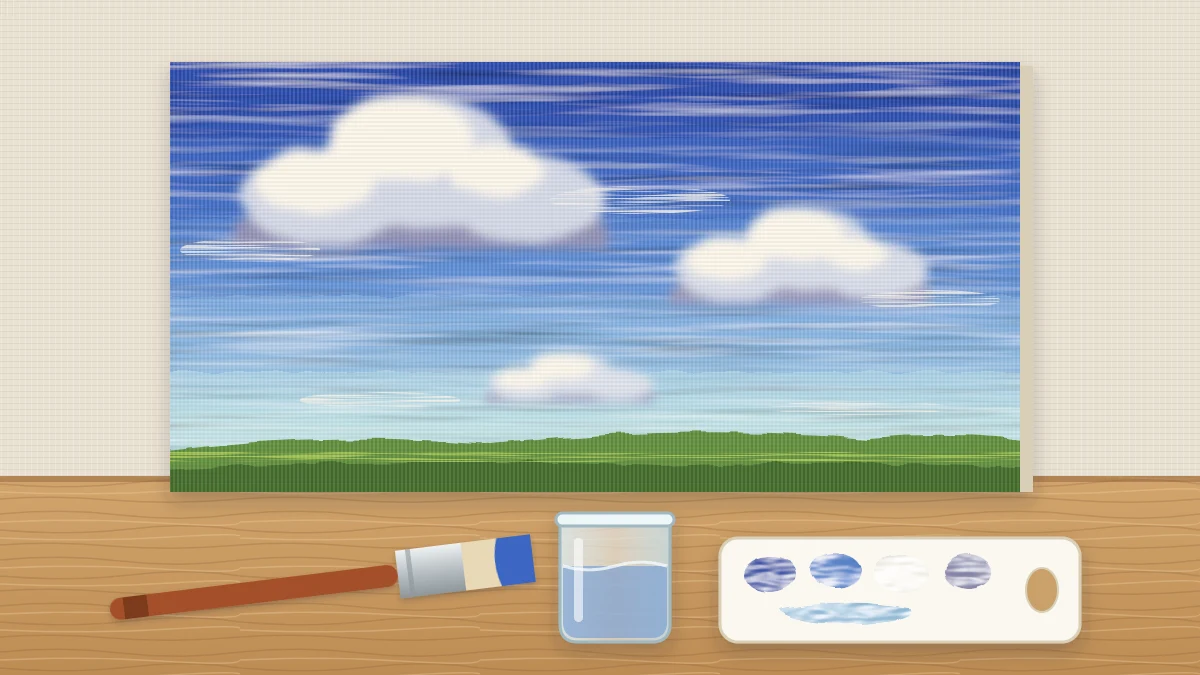
Paint a natural daytime sky: a blue gradient that is deeper at the top and paler near the horizon, then soft clouds with bright tops, flat gray-violet bases and faded edges.
At a glance
Brushes and materials
- 1 in flat brush
- Old filbert or round brush for scrubbing clouds
- Clean, dry soft brush for softening
- Palette and two water jars
- Paper towels
A flat blue rectangle with white cotton balls on it is what most first skies look like. Real skies change color from top to bottom, and clouds have a light side, a shadow side and edges that fade. Once you know those two things, learning how to paint a sky becomes a short, repeatable routine.
This tutorial covers a clear daytime sky with a few soft clouds. It works as a study on its own or as the first layer of any landscape.
What you need
A sideways canvas panel of about 8 x 10 in (20 x 25 cm) is a comfortable size. Smaller is easier to blend; a large canvas dries before you can cross it.
- Colors: titanium white, ultramarine blue, phthalo blue, crimson, burnt sienna and yellow ochre.
- Brushes: a 1 in (2.5 cm) flat for the sky, and an old, slightly worn filbert or round for clouds. A second, clean and dry soft brush is useful for softening edges.
- Also: a palette, two water jars and plenty of paper towels.
Why the sky is not one blue
Look at a clear sky from overhead down to the horizon. Straight above, the blue is deep and leans slightly toward violet. Lower down it grows paler and shifts toward a faint green-blue, and just above the land it can be nearly white.
Two blues from a basic set match this well. Ultramarine is the warmer, violet-leaning blue for the top. Phthalo blue is the greener one, and a tiny amount in a lot of white gives the pale band near the horizon.
Paint the blue gradient
Mix all three colors before you touch the canvas, because there is no time to mix mid-blend.
- Top: ultramarine with white, about two parts blue to one of white.
- Middle: the top mix with roughly the same amount of white again.
- Horizon: mostly white with a very small touch of phthalo blue.
- Dampen the flat brush and blot it, so the paint glides without running.
- Paint the top third with the deepest mix in long horizontal strokes from edge to edge.
- Paint the middle third with the middle mix, overlapping the band above slightly.
- Paint the bottom third with the horizon mix.
- Blend the joins. Wipe the brush, then sweep back and forth along each boundary with light horizontal strokes, moving a little up and a little down until the steps disappear.
- Let it dry until touch-dry, roughly 10 to 20 minutes.
Work quickly and keep every stroke horizontal. The full method, including what to do when a band dries too soon, is in the tutorial on how to paint a gradient, and other ways to soften a join are covered in the guide to blending acrylic paint.
If the gradient ends up stripy, do not keep brushing half-dry paint. Let it dry fully and paint the whole thing again on top. A second pass is usually smoother because the surface is no longer absorbent.
Scrub in soft clouds
Clouds go on once the sky is dry, so that the blue does not mix into them. The trick is a nearly dry brush and paint that is not quite white.
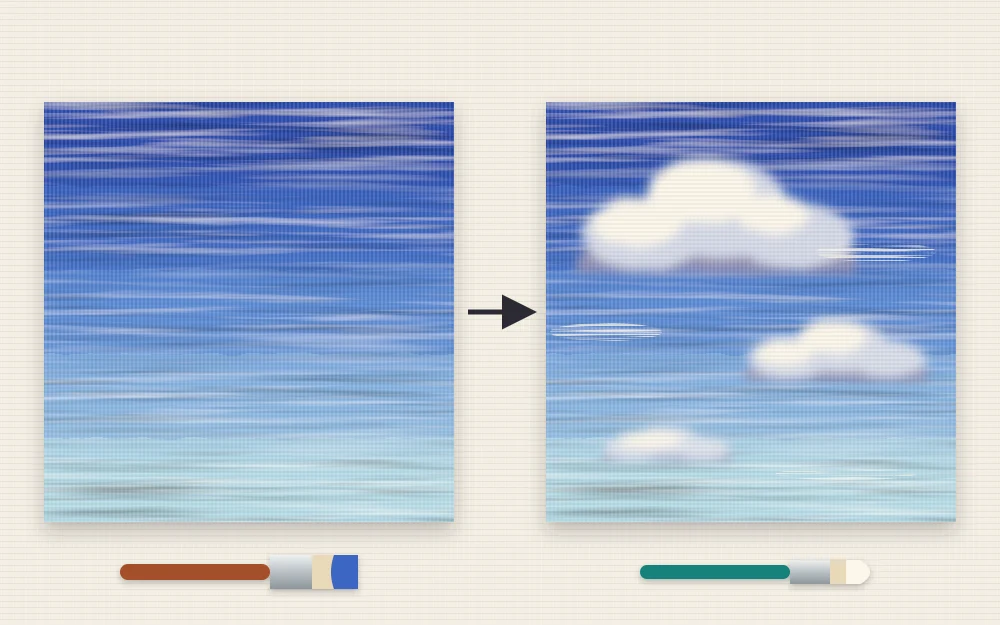
Mix two cloud colors:
- Off-white: titanium white with the smallest speck of yellow ochre, just enough to take the chill off.
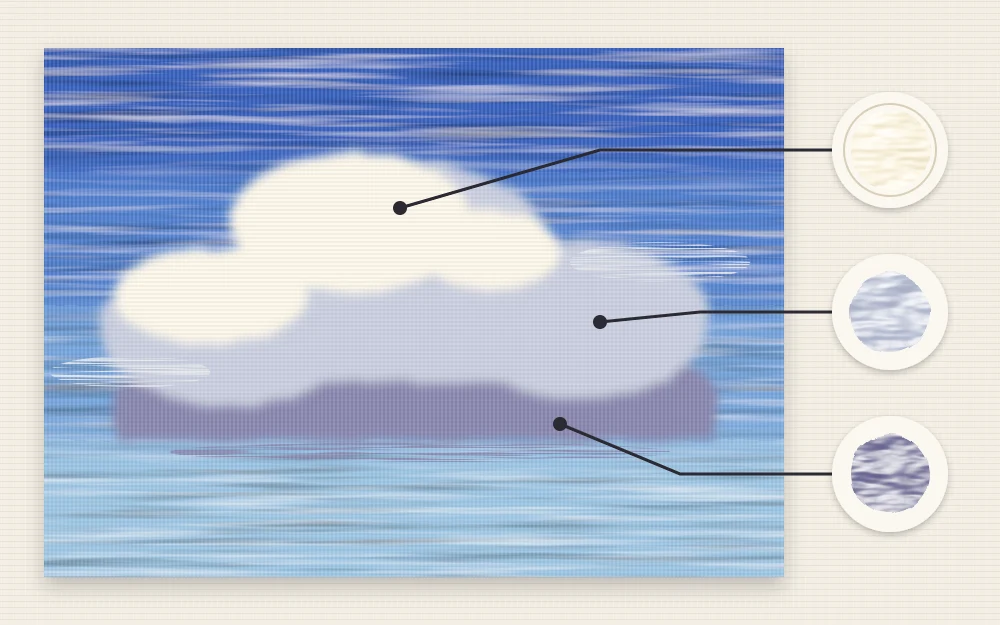
- Gray-violet: ultramarine with a touch of crimson and a touch of burnt sienna, lightened with white to a soft mid value. It should be only a little darker than the sky around it.
- Decide where the light comes from. Here it comes from the upper left.
- Load and wipe. Pick up a little off-white on the worn brush, then wipe most of it off on a paper towel.
- Scrub the shape. Using small circular motions, rub in a loose cloud shape with a lumpy top and a flatter bottom. The blue should show faintly through the thin paint at the edges.
- Add the base. With the gray-violet and the same scrubbing motion, paint the underside as a fairly flat, horizontal band. Let it merge upward into the off-white.
- Brighten the tops. With a slightly thicker load of off-white, restate the upper left bumps of the cloud so they are the lightest part of the painting.
- Soften the edges. While the paint is still damp, flick the clean dry brush lightly over the right-hand and lower edges so they fade into the sky. Keep one or two crisper edges on the light side.
Tip
Test the brush on scrap paper first. If it leaves a solid, wet mark, there is too much paint on it. You want a broken, powdery mark that builds up slowly.
Arrange clouds so the sky has depth
Clouds follow the same rule as everything else in a landscape: they look smaller as they get farther away. The ones high on the canvas are nearly overhead and close to you; the ones just above the horizon are far off.
- Make the highest cloud the largest and the tallest.
- Make clouds lower on the canvas smaller, flatter and closer together.
- Near the horizon, reduce them to thin, pale streaks with almost no gray underneath.
- Use an odd number, three or five, in clearly different sizes, with uneven gaps between them.
Three common faults and their fixes
- Pure white clouds. White all over leaves no room for a highlight, so the cloud looks cut out. Glaze a thin gray-violet over the lower two thirds and keep the brightest off-white for the top edge only.
- Even spacing. A row of same-sized clouds at equal intervals looks like wallpaper. Paint one out with sky color mixed to match that height, let it dry, and enlarge a neighbor instead.
- Hard outlines. A sharp edge all the way round makes a cloud look solid. Scrub a little sky color over the edge with a nearly dry brush until it breaks up.
Using the sky in a landscape
Because land is painted over the bottom of the sky, carry the pale horizon color a little lower than where the land will start. That way no gap of bare canvas appears between them.
When the sky is dry, it is ready for hills and trees. The simple five-layer landscape picks up from exactly this point and builds the scene forward from the horizon.
Frequently asked questions
What colors do I need to paint a blue sky in acrylic?
Titanium white and two blues cover most daytime skies: ultramarine for the deeper upper sky and a very small amount of phthalo blue in white for the paler, greener band near the horizon. A touch of crimson and burnt sienna turns the blue into a soft gray-violet for cloud shadows.
Should I paint clouds while the sky is wet or dry?
For soft daytime clouds, wait until the sky is touch-dry. Scrubbing off-white over dry blue with a nearly dry brush keeps the cloud color clean and lets you build it up gradually. On a wet sky the white mixes into the blue and turns pale blue instead.
Why do my clouds look like cotton balls?
Usually they are pure white, evenly rounded and sharply outlined. Give each cloud a flatter gray-violet base, keep the brightest off-white for the side facing the light, soften most of the edges into the sky, and vary the sizes so no two clouds match.