
Why Getting Humidity Right Makes or Breaks Your Microgreens
The best humidity for microgreens depends on the growth stage — but here’s the quick answer most growers need:
| Growth Stage | Ideal Humidity Range |
|---|---|
| Germination (blackout period) | 50-80% relative humidity (RH) |
| Active growth (under lights) | 40-60% RH |
| Pre-harvest | 40-50% RH |
Bottom line: Start high, then bring it down. Too much moisture after germination is where most growers run into trouble.
Growing microgreens is one of the fastest ways to add fresh, nutrient-dense food to your meals. We’re talking harvests in as little as 7-14 days, right on your kitchen counter.
But here’s the thing most beginner guides gloss over: humidity is the variable that quietly determines whether your tray thrives or turns into a fuzzy, moldy disappointment.
Get it right and you’ll have crisp, flavorful greens packed with nutrients. Get it wrong — even slightly — and you’re looking at mold, wilting, or poor germination. One experienced grower described losing an entire crop overnight after temperatures crept above 85°F in a high-humidity environment. That’s how fast things can go sideways.
The good news? Humidity isn’t hard to manage once you understand what your microgreens actually need at each stage of growth.
Defining the Best Humidity for Microgreens by Growth Stage
When we talk about the best humidity for microgreens, we are actually talking about Relative Humidity (RH). This is a measure of how much water vapor is in the air compared to the maximum amount the air could hold at that specific temperature.
Microgreens are fascinating little plants. Unlike their mature counterparts, they are in a state of rapid cellular expansion. They “breathe” through tiny pores called stomata, absorbing carbon dioxide and releasing moisture through a process called transpiration. If the air is too dry, they lose water faster than their tiny roots can drink it up, leading to wilting. If the air is too “thick” with moisture, transpiration stops, nutrient movement stalls, and mold moves in to throw a party we definitely weren’t invited to.
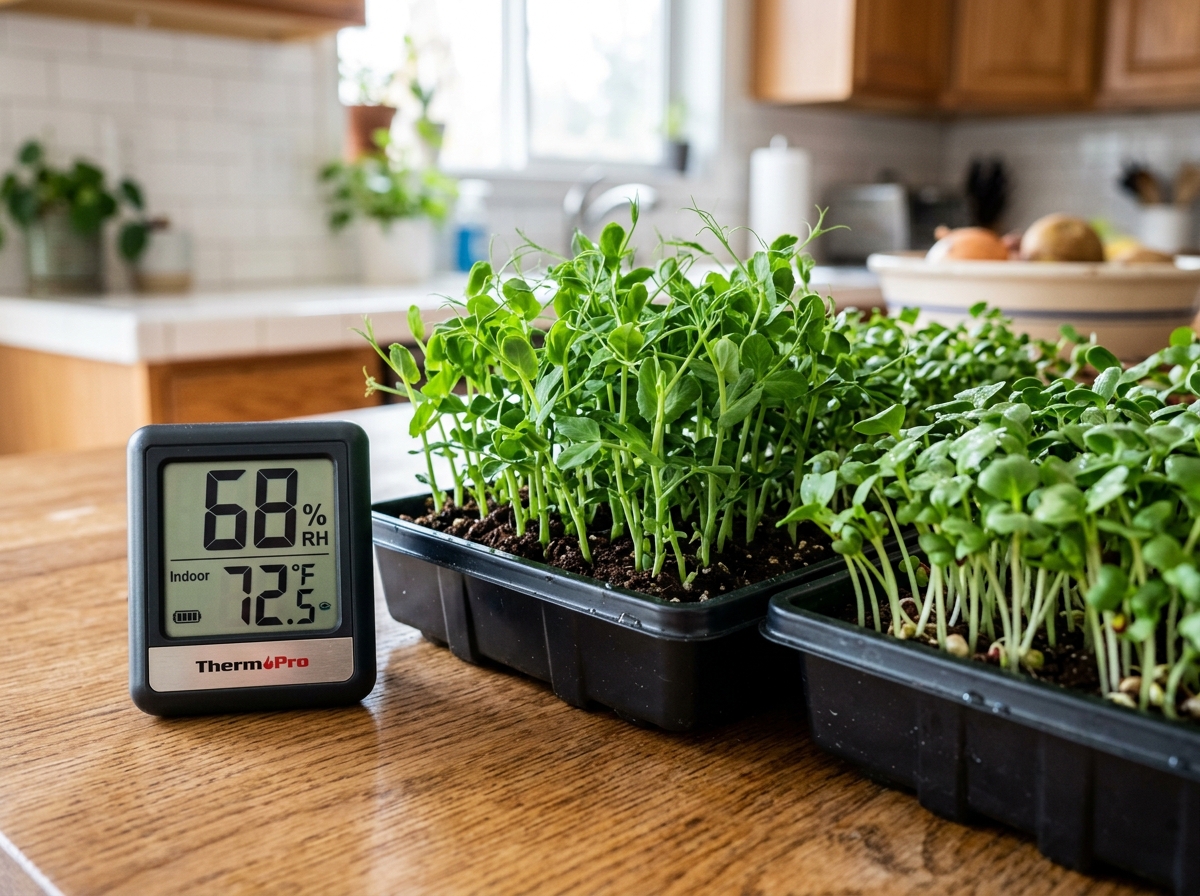
To keep things simple, we like to view humidity as a sliding scale that moves downward as the plants move upward. Maintaining Ideal Humidity for Indoor Microgreens Growth is about finding that “Goldilocks Zone” where the air is moist enough to soften seed coats but dry enough to keep fungal pathogens at bay.
Ideal Humidity for Microgreens During Germination
The first few days of a microgreen’s life are spent in the “blackout period.” This is when we keep the seeds in the dark, often with a weight on top, to encourage strong root development. At this stage, the best humidity for microgreens is high—ideally between 50% and 80%.
Why so humid? Seeds need to absorb water to activate the enzymes that trigger growth. A humid environment softens the seed coat, making it easier for the “radicle” (the baby root) to break through. Many of us use humidity domes or even stack trays on top of each other to trap the moisture evaporating from the soil.
During this phase, we recommend:
- Misting: 1-2 times daily to keep the surface damp but not swampy.
- Temperature: Aim for 75-80°F to speed up the process.
- Monitoring: Check daily. If you see fuzzy white “root hairs,” don’t panic! They are often mistaken for mold, but they are just the plant’s way of reaching for water. A quick spray of water will make root hairs “disappear” against the root, while mold will stay messy and clumped.
For a deeper dive into these early days, check out our Step-by-Step Microgreen Guide and learn more about Maintaining Ideal Humidity for Indoor Microgreens Growth.
Maintaining the Best Humidity for Microgreens in the Growth Phase
Once those first tiny leaves (cotyledons) emerge and you move your trays under the lights, the rules change. The best humidity for microgreens now drops to a range of 40-60%.
As the plants develop true leaves, they become more efficient at moving water. If the humidity stays at 80%, the air becomes stagnant. This is the “pathogen paradise” we want to avoid. By lowering the humidity to around 50%, we encourage the plants to transpire. This “pulls” water and dissolved minerals from the roots up into the leaves, strengthening the stems and boosting nutrient density.
To manage this transition successfully:
- Bottom Watering: This is our “secret sauce.” Instead of getting the leaves wet, pour water into the bottom tray. This keeps the canopy dry and drastically reduces the risk of mold. Aim for about 1.5 to 2 cups of water daily for a standard 10×20 tray.
- Airflow: Start those fans! A gentle breeze makes the plants “work harder” to stand up, leading to thicker, crunchier stems.
- Measurement: Keep your hygrometer at canopy level. The humidity at the ceiling is very different from the humidity tucked between thousands of tiny stems.
Consistency is the quiet hero here. You can find more tips on The Watering Regimen for Thriving Microgreens and further advice on Maintaining Ideal Humidity for Indoor Microgreens Growth.
The Impact of Humidity Extremes: Mold vs. Wilting
When humidity levels stray from the ideal, the consequences are visible—and sometimes smelly.
High Humidity Hazards: If your humidity consistently sits above 70% during the growth phase, you are flirting with damping-off. This is a fungal disease that causes the stems to rot at the soil line, making your beautiful greens collapse in a sad, soggy heap. You might also notice a foul smell or yellowing leaves. High humidity also dilutes the flavor of your greens, as the plants are essentially “waterlogged.”
Low Humidity Lows: On the flip side, if the air is too dry (below 30-35%), your microgreens will struggle. Germination will be patchy and slow. You’ll see wilting, even if the soil is wet, because the leaves are losing moisture faster than the stems can transport it. In desert climates or during winter when heaters are running, low humidity can also cause “tip burn” or stunted growth. Interestingly, very low humidity can concentrate flavors, but it often leads to a bitter aftertaste.
To stay on the safe side, we always recommend Effective Strategies for Preventing Formation of Mold on Microgreens and learning to Avoid These Common Mistakes in Microgreen Farming for Better Yield.
Essential Tools for Humidity Control and Monitoring
You don’t need a laboratory-grade setup, but a few key tools will make your life much easier. We’ve found that trying to “guess” the humidity is a recipe for frustration.
- Digital Hygrometer: This is non-negotiable. For about $15, you can get a device that tells you the temperature and RH. We suggest getting a WiFi-enabled version that can alert your phone if the levels go out of range.
- Oscillating Fans: These are the engines of a healthy grow room. Position them 3-4 feet away from your trays. You want a gentle “rustle” of the leaves, not a windstorm that bends them over.
- Dehumidifiers: If you grow in a basement or a humid climate, a dehumidifier is your best friend. In a 500 sq ft room, you might need two 70-pint units to keep things stable.
- Humidifiers: Conversely, if you live in a dry area, a small ultrasonic humidifier can help maintain that 50% sweet spot.
- Spray Bottles: Use a high-quality mister (like a Scotts sprayer) to avoid hand cramps during the germination phase.
For a full list of our favorites, check out the Top Tools You Need for Growing Indoor Microgreens and our Indoor Microgreens Setup for Beginners. If you’re just starting out, our Beginner Guide to Microgreen Farming is a great place to plant your first seeds.
Advanced Strategies: Airflow, Temperature, and Variety Specifics
Once you’ve mastered the basics, you can start fine-tuning. One thing we’ve learned is that not all microgreens are created equal.
- Variety Differences: Larger seeds like peas and sunflowers are “moisture magnets.” They have dense canopies that trap air, making them very prone to mold if the humidity is high. We often uncover these varieties a day early to let them breathe. On the other hand, tiny brassicas (like broccoli and kale) are a bit more forgiving but still prefer that 50% RH mark.
- Temperature Interaction: Warm air holds more moisture than cold air. This means 50% humidity at 80°F is actually “wetter” in terms of total water content than 50% at 65°F. For the best humidity for microgreens, try to keep your temperature between 65-75°F. If your room gets too hot, you must lower the humidity to prevent disease.
- Vertical Gradients: If you use a rack system, heat and moisture rise. Your top shelf will likely be warmer and more humid than the bottom shelf. Use this to your advantage! Put heat-loving varieties like amaranth or basil on the top racks and cool-loving greens like arugula on the bottom.
Frequently Asked Questions about Microgreen Humidity
How do I lower humidity in a small indoor grow space?
If your hygrometer is screaming at you, don’t panic. Start by increasing airflow with more fans. If you’re growing in a tent, use an exhaust fan to pull moist air out and bring fresh air in. Spacing your trays further apart also helps air circulate between the plants. If these don’t work, a small dehumidifier is the most effective solution. You can find more advice in our guide on Easy Indoor Gardening for Microgreens.
Can I grow microgreens in high-humidity climates?
Absolutely! We have many successful growers in the humid South. The trick is to reduce your seeding density. If you sow the seeds less thickly, there is more room for air to move between the stems. You should also uncover your trays earlier than the standard 3-4 days and keep your fans running 24/7. Choosing mold-resistant varieties like radish can also help. For more on timing, see Decoding the Growth Cycle of Microgreens.
Does humidity affect the shelf life of harvested microgreens?
Yes, and this is a big one! If you harvest microgreens when the canopy is wet or the room is very humid, they will turn into “mush” in the fridge within days. We recommend running your fans on high for 24 hours before harvest to dry out the leaves. Once harvested, store them at 41°F in a dark, sealed container. Properly dried and chilled microgreens can last 10-14 days, whereas “wet” ones might only last 2-4 days. For unique growing methods, you might also enjoy learning How to Grow Microgreens in Jars.
Conclusion
Mastering the best humidity for microgreens is less about perfection and more about observation. At Financelyx, we believe that every tray is a lesson. Whether you’re a seasoned pro or just starting your journey with Elena Monroe’s nutrient-dense recipe ideas, keeping an eye on your humidity will ensure your snacks are as flavorful as they are healthy.
Remember the “Goldilocks” rule: Start high for germination, then bring it down to 50% for growth. Use your fans, trust your hygrometer, and don’t be afraid to adjust based on what your plants are telling you.
Ready to take your indoor garden to the next level? Explore more of our Growing Tips or explore our essential tools and supplies for microgreen success to get everything you need for a bumper crop. Happy growing!
