
Why Humidity Control Makes or Breaks Your Microgreens Harvest
A microgreens dehumidifier setup guide helps you dial in the one environmental factor most growers overlook until it’s too late: moisture in the air.
Here’s the quick answer to get you started:
How to set up a dehumidifier for microgreens (at a glance):
- Measure your grow space in cubic meters (m³), not just floor area
- Choose the right capacity — around 2-3 units of 70-75 pint dehumidifiers for a 500 sq ft grow area
- Place the unit high — warm air near the ceiling holds the most moisture
- Set your target humidity by growth stage: 50-80% germination, 40-60% grow-out, 40-50% pre-harvest
- Use auto-drain to avoid the unit shutting off when the bucket fills
- Pair with fans — never let air go stagnant
Microgreens release moisture into the air as they grow. This is called transpiration, and it’s completely normal. But in an enclosed grow room, tent, or rack setup, that moisture builds up fast — especially when you’re watering daily, sometimes two or three times a day.
The result? Humidity climbs above 70%. At that point, you’re not just risking slow growth. You’re rolling out a welcome mat for mold, damping-off, and bacterial disease.
The good news: a properly sized and placed dehumidifier solves most of this. The tricky part is knowing how to set it up correctly.
The Science of Humidity in Microgreens Farming
In our experience at Financelyx, we’ve seen that growing microgreens is a bit like conducting a delicate orchestra. Every element—light, water, and air—must play in harmony. Central to this harmony is the process of transpiration. This is essentially the plant “breathing” out water vapor. While it’s a sign of a healthy, growing plant, in a confined indoor space, this vapor quickly turns the air soup-thick.
If the relative humidity (RH) stays above 70% for too long, the plants stop transpiring effectively. Think of it like trying to dry off with a soaking wet towel; the air simply cannot hold any more moisture, so the water stays on the plant. This leads to several critical issues:
- Pathogen Defense: High humidity is the primary driver for “damping-off,” a soil-borne fungal disease that can wipe out an entire tray of broccoli or radish greens overnight.
- Mold Prevention: Mold spores are everywhere, but they only activate when they find warm, moist, stagnant air. A dehumidifier acts as your first line of defense.
- Root Rot Prevention: When air is too humid, the growing medium stays saturated for too long. This starves the roots of oxygen, leading to rot.
Maintaining ideal humidity for indoor microgreens growth is not just about buying a machine; it’s about creating a synergy between the dehumidifier and your airflow system. Without proper circulation, you’ll end up with “micro-pockets” of high humidity right at the tray level, even if your wall-mounted sensor says everything is fine.
Ideal Humidity Targets by Growth Stage
One of the most common mistakes we see is growers setting their dehumidifier to a single number and leaving it there forever. In reality, microgreens have different needs as they age.
During the germination phase, seeds actually need high humidity (75-90%) to soften the seed coat and encourage the first root (the radicle) to emerge. This is why we use humidity domes or stack trays. However, once those domes come off and the lights go on, the humidity must drop.
| Growth Stage | Ideal Humidity (RH) | Temperature Range | Why it Matters |
|---|---|---|---|
| Germination | 50% – 80% | 70°F – 85°F | Softens seed coats; prevents drying out. |
| Grow-out | 40% – 60% | 65°F – 75°F | Prevents mold; encourages strong stems. |
| Pre-harvest | 40% – 50% | 60°F – 70°F | Toughens the greens; ensures dry leaves for better shelf life. |
Choosing the Right Equipment for Your Microgreens Dehumidifier Setup Guide
When you’re looking for the heart of your microgreens dehumidifier setup guide, don’t just look at the square footage on the box. In professional farming, we measure by room volume (m³). A room with 12-foot ceilings has much more air to process than a basement with 7-foot ceilings.
There are two main types of dehumidifiers you’ll encounter:
- Refrigerant Dehumidifiers: These are the most common. They work by pulling air over cold coils, causing moisture to condense into a tank. They are incredibly effective in typical grow room temperatures (65°F–80°F).
- Desiccant Dehumidifiers: These use a chemical material to absorb water. They are better for very cold spaces (like an unheated garage in winter) but can be less energy-efficient for large-scale grows.
For an indoor microgreens setup for beginners, a portable refrigerant unit is usually the best bet. Look for models with auto-drain pipes. Trust us—you do not want to be the person who loses a $500 harvest because the dehumidifier tank filled up at 2 AM and the machine shut itself off.
Sizing Your Dehumidifier for Home vs. Commercial Scales
The scale of your production dictates your pint capacity. In dehumidifiers, “pints” refers to how many pints of water the machine can pull from the air in 24 hours.
- Small Home Grow (1-10 trays): A small 20-30 pint portable unit is usually sufficient.
- Medium Scale (Rack System in a Spare Room): A 50-pint unit is the “sweet spot” for most hobbyists turning pro.
- Commercial Scale (500 sq ft or more): You will likely need 2-3 high-capacity 70-75 pint units.
When considering your ROI (Return on Investment), an oversized unit is better than an undersized one. An undersized unit will run 24/7, spike your electricity bill, and eventually burn out its compressor. Check out our list of the top tools you need for growing indoor microgreens to see how a quality dehumidifier fits into your budget.
Optimal Placement and Integration Strategies
Placement is where many growers fail. We’ve seen people put their dehumidifier on the floor in the corner of the room and wonder why their top-shelf trays have mold.
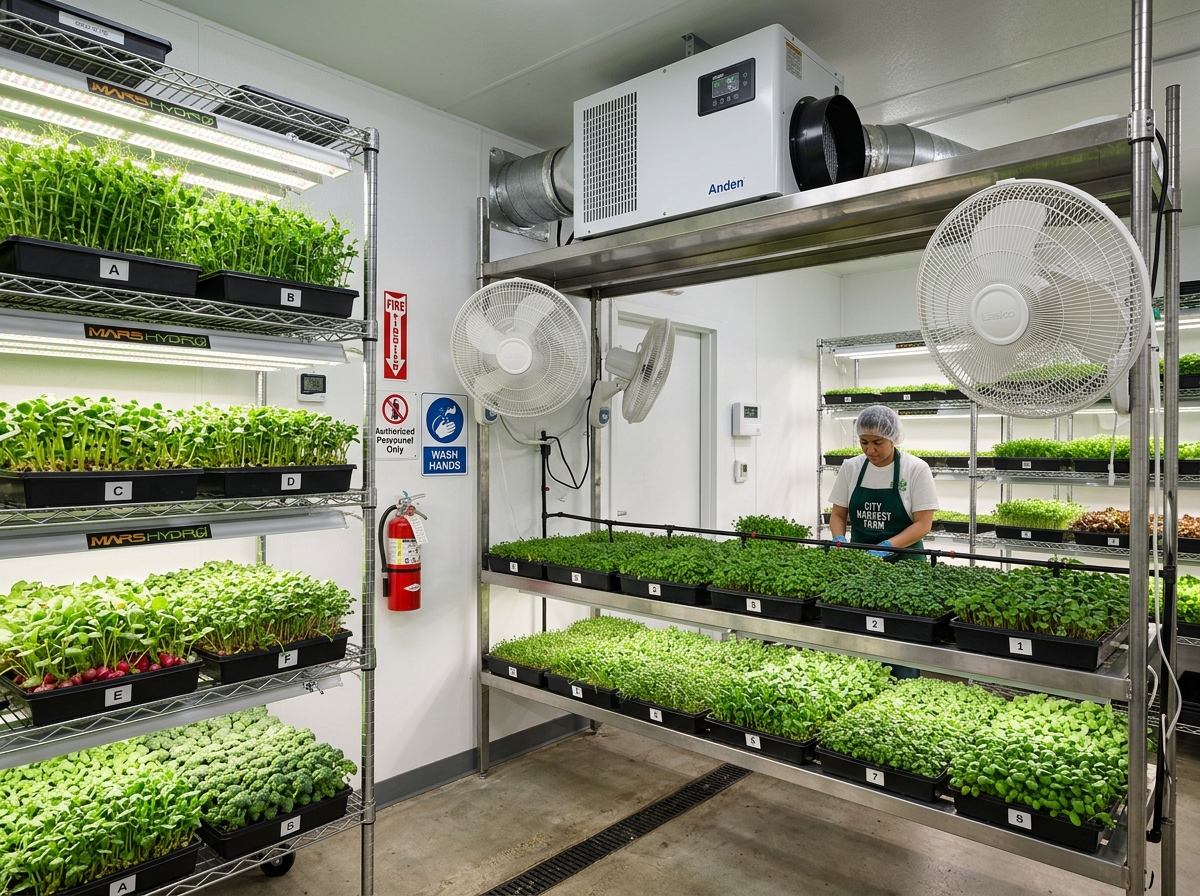
The Ceiling Rule: Warm air holds more moisture than cold air. Because heat rises, the most humid air in your room is usually hovering near the ceiling. By mounting your dehumidifier high—or at least placing it on a sturdy shelf—you capture that “wet” air much more efficiently.
To maximize efficiency, you want to create an airflow loop.
- Place an oscillating fan on one side of the room to push air across the trays.
- Position the dehumidifier’s intake so it catches that moving air.
- Ensure the “dry” air exhausted by the dehumidifier is circulated back into the room (but not pointed directly at the plants, which can cause “windburn”).
Integrating with HVAC and Exhaust Systems
Your dehumidifier shouldn’t work in a vacuum. It needs to play nice with your HVAC and exhaust fans. In larger setups, we often use positive pressure. This means we use an intake fan to pull in filtered fresh air and an extractor fan to push out old, humid air.
To calculate your needs, use the CFM (Cubic Feet per Minute) formula:
Fan CFM = Volume of room x Air Exchange Rate (Usually replacing the air every 3-5 minutes).
When you integrate finding the right indoor gardening accessories for your microgreens, consider an automated controller. These smart plugs can turn your dehumidifier on or off based on a remote sensor placed right in the middle of your plant canopy. This prevents the room from becoming too dry, which can lead to wilting and stunted growth.
Maintenance and Troubleshooting
A dehumidifier is a workhorse, but it’s not “set it and forget it.” Because grow rooms are often dusty (from coco coir or soil), the filters clog quickly. A clogged filter makes the machine work twice as hard for half the result.
The Maintenance Checklist:
- Weekly: Remove and wash the air filter. Dust the exterior of the unit.
- Monthly: Check the auto-drain line for algae or “slime” buildup. A shot of vinegar down the line can keep it clear.
- Quarterly: Inspect the coils. If they are dusty, use a soft brush or compressed air to clean them.
Using must-have indoor gardening tools for microgreen cultivation like a calibrated digital hygrometer is essential. Don’t trust the reading on the dehumidifier itself; it only knows the humidity at the machine. You need to know the humidity at the plant.
Advanced Maintenance for Your Microgreens Dehumidifier Setup Guide
For those running professional operations, we recommend keeping a performance log. If you notice your machine used to pull 2 gallons of water a day but now only pulls 1 gallon under the same conditions, your compressor might be failing or your coils might be iced over.
Consistent easy indoor gardening for microgreens relies on this data. If you see a humidity spike every Tuesday, you might realize it’s because that’s the day you water your heavy-drinking crops like peas and sunflowers.
Troubleshooting Your Microgreens Dehumidifier Setup Guide
Even with the best microgreens dehumidifier setup guide, things can go wrong. Here are the most common “gremlins” we encounter:
- Windburn: If the dry exhaust air from your dehumidifier blows directly onto a tray of delicate Amaranth, the leaves will curl and turn brown. This looks like underwatering, but it’s actually “windburn.”
- The “Short Cycle”: If your dehumidifier is too close to your intake fan, it might pull in fresh air, dry it, and exhaust it immediately without ever touching the humid air near your plants.
- Manual Emptying Mistakes: We’ve all been there. You forget to empty the bucket, the unit shuts off, and you wake up to a room at 85% humidity and “fuzzy” white mold on your expensive cilantro seeds. Use a drain hose!
- Icing Up: If your grow room is cool (below 60°F), the coils in a refrigerant dehumidifier can freeze. Look for a unit with an “auto-defrost” feature.
Frequently Asked Questions about Microgreens Humidity
How do I calculate the right dehumidifier size for my grow room?
Start by calculating the volume of your room (Length x Width x Height). For a standard 10×10 room with 8-foot ceilings (800 cubic feet), a 50-pint unit is usually perfect. However, if you have more than 40 trays of high-transpiration crops like peas, you should bump up to a 70-pint unit to handle the extra moisture load from watering.
Where is the best place to put a dehumidifier in a grow tent?
In a grow tent, space is tight. If possible, place the dehumidifier outside the tent and use your intake fan to pull the dry air in. If it must be inside, place it on the floor but use a small fan to lift the air upward. Never place it directly under a light, as the heat from the light and the heat from the dehumidifier can create a “hot spot” that wilts your greens.
Can I use a dehumidifier instead of an exhaust fan?
Not effectively. While a dehumidifier removes water, an exhaust fan removes heat and replenishes CO2. Microgreens need fresh CO2 to grow. Using a dehumidifier alongside an exhaust system is the gold standard. If you only use a dehumidifier, the air will become “stale,” and your plants may grow slower due to CO2 depletion.
Conclusion
At Financelyx, we believe that the best microgreens are grown with a mix of science and soul. Whether you are growing spicy radish for your morning avocado toast or supplying local chefs with nutrient-dense snacks, mastering your environment is key.
By following this microgreens dehumidifier setup guide, you are doing more than just preventing mold; you are ensuring that every leaf is packed with the flavor and nutrients our expert writers, like Elena Monroe, love to feature in our recipe ideas. A stable climate leads to consistent harvests, and consistent harvests lead to a healthier lifestyle for you and your family.
Ready to level up your grow space? Explore our tools and supplies category for more expert advice on building the ultimate indoor farm. Happy growing!
