
Why Humidity Control Is the Secret to Thriving Microgreens
A dehumidifier optimizes microgreens growth by keeping moisture levels in the sweet spot — preventing mold, supporting nutrient uptake, and producing denser, more flavorful harvests.
Quick answer: How a dehumidifier helps microgreens
- Prevents mold and disease — humidity above 70% creates ideal conditions for pathogens
- Boosts nutrient uptake — steady moisture levels (40-60% RH) help roots absorb nutrients efficiently
- Improves density and yield — controlled transpiration leads to stronger stems and fuller trays
- Protects flavor and nutrition — stable conditions preserve the antioxidants and compounds that make microgreens worth growing
- Works in any space — especially useful in basements and grow tents where humidity is harder to manage naturally
Microgreens are one of the most nutrient-dense foods you can grow at home. They’re ready to harvest in just 7-21 days, and they pack intense flavor into a tiny package — perfect if you want wholesome food without spending hours in the kitchen.
But here’s the catch: microgreens are extremely sensitive to their environment.
Humidity is the variable most beginners overlook. Too high, and you’re fighting mold. Too low, and your greens dry out before they can thrive. Research shows that humidity above 70% increases disease risk and slows growth, while levels between 40-60% keep plants healthy and productive.
A small dehumidifier changes the equation entirely. It gives you consistent, predictable control — the kind that turns a patchy first attempt into reliable, high-quality trays of nutrient-dense greens.
Whether you’re starting with 2-3 trays in a basement or thinking about scaling up, understanding how humidity affects your crop is the first step to getting professional results.
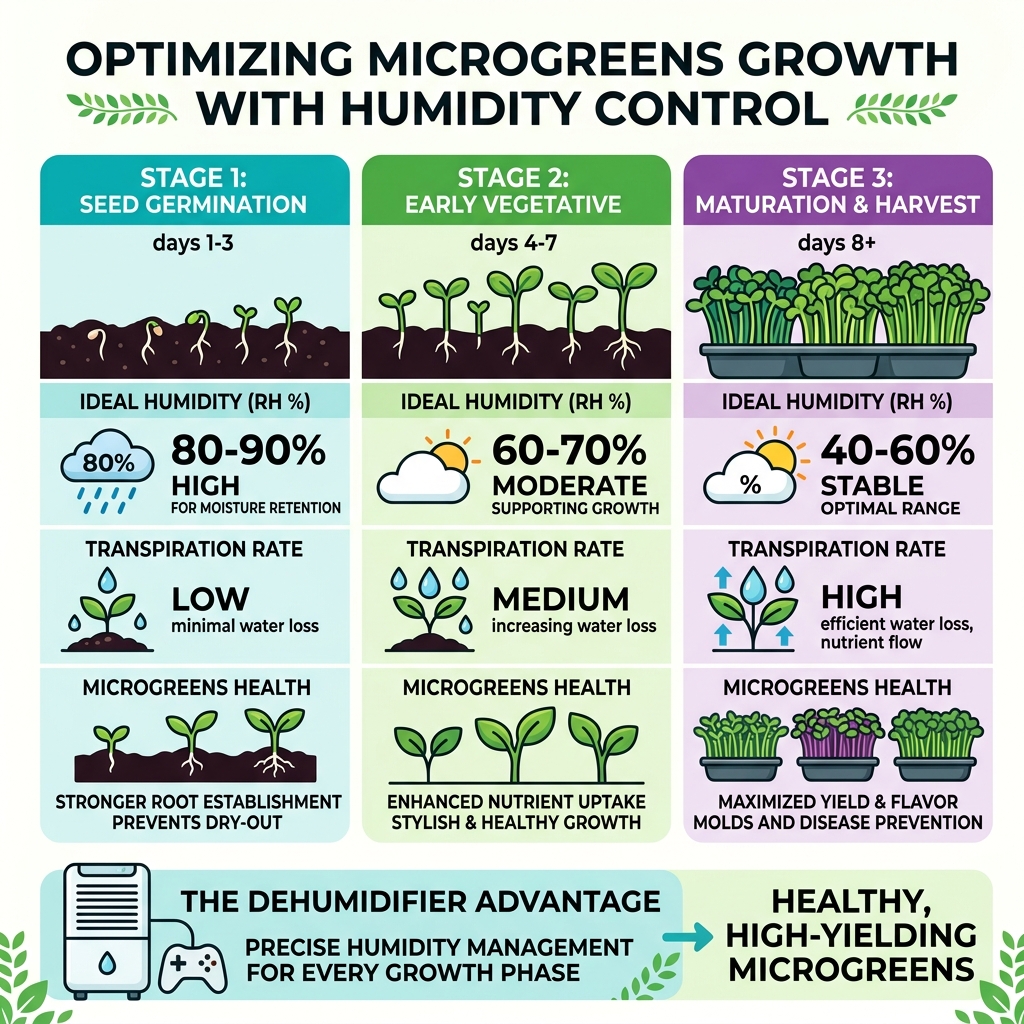
Why a Dehumidifier Optimizes Microgreens Growth and Yield
When we talk about how a dehumidifier optimizes microgreens growth, we aren’t just talking about keeping things dry. We’re talking about managing the biological “engine” of the plant.

Transpiration and Nutrient Uptake
Plants “breathe” and move water through a process called transpiration. Water evaporates from the leaves, which creates a vacuum that pulls more water (and dissolved nutrients) up from the roots. If the air is too humid (above 70%), the air is already “full” of water. The leaves can’t evaporate moisture, the vacuum stops, and the plant stops taking in nutrients. By using a dehumidifier to maintain a Relative Humidity (RH) of 40-60%, we ensure this nutrient pump stays active, leading to faster growth and higher biomass.
Pathogen and Mold Prevention
High humidity is the primary cause of the “greenhouse effect” gone wrong. Stagnant, moist air is a playground for fungal pathogens like Pythium (damping-off) and various molds. Statistics show that humidity exceeding 70% leads to a significant increase in disease risk. According to The key environmental controls of microgreens farming, maintaining airflow and lower humidity is critical for preventing these issues before they ruin a tray.
Root Health and Density
When the air is properly managed, roots stay healthy because the growing medium isn’t constantly oversaturated by condensation. This leads to a denser canopy. We’ve found that a controlled environment prevents the “leggy” or weak stems that happen when plants are struggling to transpire. For more on the basics of moisture management, check out our guide on maintaining-ideal-humidity-for-indoor-microgreens-growth/.
Setting the Stage: Ideal Humidity and Temperature Ranges
To grow like a professional, we need to treat the germination phase and the growth phase differently. Microgreens have different “comfort zones” depending on how old they are.
| Growth Phase | Ideal Humidity (RH) | Ideal Temperature | Key Goal |
|---|---|---|---|
| Germination | 50% – 80% | 70°F – 75°F | Soften seed coat, trigger sprout |
| Blackout | 50% – 70% | 70°F – 75°F | Rapid stem elongation |
| Growth (Light) | 40% – 60% | 65°F – 75°F | Nutrient uptake, mold prevention |
Germination and the Blackout Period
During the first 2-4 days, we actually want higher humidity. This is why many growers use humidity domes or “blackout” lids. A range of 50-80% RH helps the seeds soften and sprout evenly. However, even here, we must be careful. If the humidity stays at 80% once the lights go on, you’re asking for trouble.
The Growth Phase and Vapor Pressure Deficit (VPD)
Once the “covers” come off and the lights go on, the dehumidifier optimizes microgreens growth by dropping that RH to the 40-60% range. This is where the concept of Vapor Pressure Deficit (VPD) comes in. VPD is basically the difference between how much moisture the air can hold and how much it is holding. If the VPD is too low (high humidity), the plants can’t sweat. If it’s too high (very dry air), they wilt. Targeting 70-75°F with 50% humidity is the “Goldilocks” zone for most varieties.
For a deeper dive into these environmental variables, see How to Optimize Light, Temperature, and Humidity for Peak Growth – Deliseeds and our internal resource on maintaining-ideal-humidity-for-indoor-microgreens-growth-2/.
How a dehumidifier optimizes microgreens growth during the growth phase
Post-blackout is the most critical time for dehumidification. As the plants grow, they create a “micro-climate” under their leaves. Without a dehumidifier and fans to break up this stagnant moisture, the leaf surfaces stay wet, leading to “damping off.” A dehumidifier pulls that excess moisture out of the room, allowing for consistent leaf surface evaporation and stronger, crunchier greens.
How to Choose and Position Your Dehumidifier
If you’re growing in a basement or a spare room, you can’t just set a dehumidifier anywhere and hope for the best.
Room Volume and Basement Challenges
Basements are notorious for “holding” moisture. Before buying equipment, measure your space in cubic feet. You want a unit rated for the square footage of the entire room, not just the rack. One expert insight from the research suggests positioning dehumidifiers near the ceiling. Why? Because warm air rises and holds more moisture than cold air; pulling the humid air from the top of the room is often more efficient.
Grow Tent Isolation
If you are using a grow tent, you have a choice: put the dehumidifier inside the tent or in the room where the tent pulls its air from. For small tents, putting a large dehumidifier inside can raise the temperature too much. It is often better to dehumidify the “lung room” (the basement or bedroom) so the intake fans pull in perfectly treated air. For more on this, read Temperature and Humidity Control for Microgreens Cultivation. and humidity-control-101-stop-the-mold-and-start-the-growth/.
Key Features to Look For:
- Auto-Restart: Essential if you have a power flicker. You don’t want your humidity to spike to 90% while you’re at work because the unit didn’t turn back on.
- Drainage Options: Look for a unit with a hose attachment (gravity drain) so you don’t have to empty a bucket twice a day.
- Integrated Humidistat: This allows you to set a target (like 50%) so the unit only runs when needed, saving electricity.
Selecting a dehumidifier that optimizes microgreens growth for small-scale setups
For beginners with 2-3 trays, a small “Peltier” (thermoelectric) dehumidifier might seem tempting because they are under $50. However, these are often too weak for the massive amount of moisture released by 1020 trays of microgreens. We recommend a small compressor-based unit. It might cost a bit more upfront, but it is much more effective at scaling as you move from 3 trays to a full rack of 20+ trays.
Step-by-Step: Integrating Humidity Control into Your Workflow
Managing your environment is a daily habit, not a “set it and forget it” task.
- Baseline Measurement: Before you even plant your first seed, run a digital hygrometer in your space for 24 hours. See what the “natural” humidity is.
- Strategic Fan Placement: A dehumidifier optimizes microgreens growth best when paired with fans. Use small oscillating fans to move air across the trays, not directly at them. Direct, heavy wind can dry out the soil too fast or damage delicate stems.
- Bottom Watering: This is a game-changer. By adding water to the bottom tray rather than misting from the top, you keep the leaves dry. This drastically reduces the workload of your dehumidifier and keeps mold at bay. For more strategies, see effective-strategies-for-preventing-formation-of-mold-on-microgreens/.
- Daily Monitoring: Check your hygrometer every morning. If you see a spike above 65%, check your dehumidifier bucket or settings. Consistency is what prevents the “stress cycles” that lead to bitter-tasting greens.
- Seasonal Adjustments: Your AC in the summer and heater in the winter will also affect humidity. You may need your dehumidifier more in the humid “shoulder seasons” (Spring and Fall) when the HVAC isn’t running as much.
For more maintenance tips, check out maintaining-ideal-humidity-for-indoor-microgreens-growth-3/.
Frequently Asked Questions about Microgreens Humidity
Can I use a dehumidifier inside a small grow tent?
Yes, but be careful. Compressor dehumidifiers exhaust warm air. In a small 2×4 or 4×4 tent, this can raise the temperature above the ideal 75°F. If you put it inside, ensure you have excellent exhaust ventilation to pull that heat out. Many growers find it easier to dehumidify the room outside the tent.
What are the signs that my humidity is too high?
The most obvious sign is white, fuzzy mold (don’t confuse this with root hairs, which are straight and attached to the root!). Other signs include “damping off” (stems collapsing at the base), yellowing leaves, or a general “swampy” smell in your grow area. If you see condensation on the walls of your trays, your humidity is definitely too high.
Are there low-cost alternatives to commercial dehumidifiers?
If you’re on a very tight budget, you can use high-volume ventilation (moving air out of the room with an exhaust fan) or moisture absorbers like calcium chloride (DampRid). However, these are “passive” and hard to control. Increasing your fan count and switching to a more porous growing medium like coco coir can help, but for a basement setup, a dedicated dehumidifier is usually the only way to get consistent results.
Conclusion
At Financelyx, we believe that the best snacks are the ones you grow yourself. Microgreens are a powerhouse of nutrition, and mastering the environment is the “secret sauce” to professional-grade yields. By understanding how a dehumidifier optimizes microgreens growth, you move from a hobbyist who “hopes for the best” to a grower who “knows the results.”
Whether you’re looking to improve the flavor profile of your radish shoots or ensure your pea shoots are crunchier than ever, controlling your humidity is the most effective investment you can make. Ready to stock up on the rest of your gear? Check out More info about microgreens tools and supplies to round out your home farm. Happy growing!
